

WhatsApp Marketing
客戶已讀不回點算?地產代理跟進客戶嘅 7 次接觸節奏表
個客啱啱睇完樓。傾咗成個鐘,佢話「幾好喎,我諗吓」,仲主動加咗你 WhatsApp。你返到公司心情唔錯。第二日你 send 一句「您好,考慮得點呀?」——已讀。第三日再 send 一次——已讀。到第五日,你手指停喺個鍵盤上面,唔敢再撳。驚煩親人,驚畀人…

In real estate transactions, the buyer's decision-making process is often lengthy and full of uncertainties. As a real estate agent, helping buyers accelerate their decisions not only increases conversion rates but also enhances client trust in your professionalism. One of the most effective strategies is to understand client needs and preferences through precise questioning and guide them to make decisions faster. This article will explore how to use precise questioning to help real estate agents close deals, enabling buyers to finalize their choices in a shorter time.
Buyers often face multiple choices when purchasing property, from location, size, and price to facilities, all of which can influence their decisions. As a real estate agent, precise questioning can effectively shorten this process. The power of precise questioning lies in its ability to not only help agents understand clients' true needs but also enable buyers to clarify their thoughts and reduce indecision.
For example, when you ask clients, 'How important do you consider properties in this area to be for you?', such a question can prompt them to consider the importance of the area, thereby helping them make trade-offs faster. These types of questions can directly uncover clients' core needs, avoiding time wasted on irrelevant details.
In real estate transactions, buyers often face decision-making difficulties due to diverse choices and an inability to prioritize. Common challenges include the following:
The core of precise questioning lies in enabling buyers to clearly understand their needs and prompting them to consider which factors are most important to them. Here are some commonly used precise questioning techniques:
Every buyer has 'must-have' and 'nice-to-have' needs. Precise questioning can help them distinguish between the two and focus on the most critical requirements. For instance, you might ask: 'Are you willing to choose a slightly more distant location to gain more space?' Such questions can help buyers understand which needs are non-negotiable and which are 'if-available, even better' requirements they can be flexible on. This type of questioning not only helps buyers clarify their priority needs but also enables you to tailor your property listing recommendations, thereby increasing the chances of a deal.
Every real estate transaction involves compromise; both buyers and sellers need to find a balance. Through precise questioning, agents can help buyers set realistic expectations and understand where they can compromise. For example, you might ask: 'Do you think this price is worth giving up an extra bedroom?' Such questions prompt buyers to think and prioritise their needs, accelerating their decision-making.
At the same time, agents should use questions to establish clients' 'compromise points'. These compromise points can help you make property listing recommendations that better align with client expectations, therebyincreasing the deal closure rate.
Case Study 1: Balancing Location and Price
An agent was introducing a new property listing in Whampoa to a young couple. The couple wanted to buy a home in the urban area but felt the property prices were a bit high due to a limited budget. Instead of immediately recommending cheaper options, the agent asked: 'If this property listing saves you 30 minutes of commute time daily, do you think it's worth spending a little more?'
This question made the couple reconsider their priority needs, as saving time was more important to them than price. Ultimately, they decided to choose this property listing closer to the urban area.
Case Study 2: Prioritising School District Homes
A couple was choosing a house in Pak Shek Kok but had doubts about whether the area could meet their children's educational needs. The agent asked: 'If this community is not only quiet but also allows your children to attend a prestigious school nearby, do you think this would meet your needs?'
This question led the couple to re-examine the educational resources in the area, and they ultimately chose the property, as their children's education was non-negotiable for them.
Real estate agents commonly face the challenge of buyer indecision during the sales process. Through precise questioning, agents can better understand buyers' needs and help them clarify their thoughts to make quick decisions. Questions like 'How important is this area to you?' or 'Can you accept this price range?' can help agents guide clients to think more deeply and facilitate decision-making.
Precise questioning is not just a tool for understanding needs but also a powerful means of driving transactions. When you master this skill, you can not only help clients make better home-buying decisions but also stand out in the competitive real estate market and improve your deal closure rate.
Please fill in the form below. We will contact you as soon as we receive your message.
個客啱啱睇完樓。傾咗成個鐘,佢話「幾好喎,我諗吓」,仲主動加咗你 WhatsApp。你返到公司心情唔錯。第二日你 send 一句「您好,考慮得點呀?」——已讀。第三日再 send 一次——已讀。到第五日,你手指停喺個鍵盤上面,唔敢再撳。驚煩親人,驚畀人…
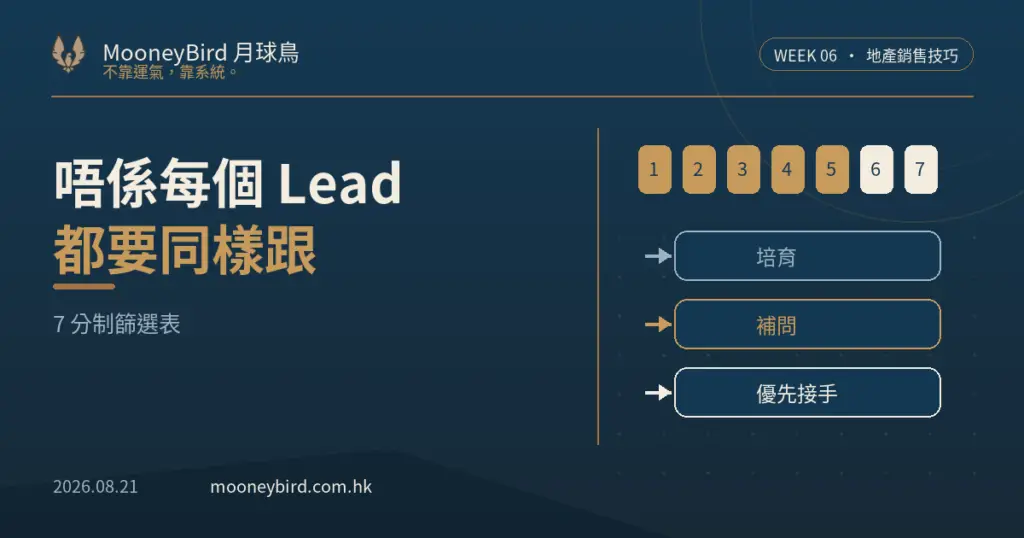
一日十個查詢,唔代表十個都要即刻約睇樓。有人只係問價,有人已經有明確時間表;如果全部放喺同一個 WhatsApp 清單,代理只會靠感覺追客。 Lead qualification…

客人睇完一個樓盤廣告,撳入 WhatsApp 問一句:『仲有冇?』如果你當時見緊客,兩個鐘後先覆,對話可能已經去咗第二個代理度。問題唔一定係你唔勤力,而係你冇一套任何同事都跟到嘅即時回覆流程。…